
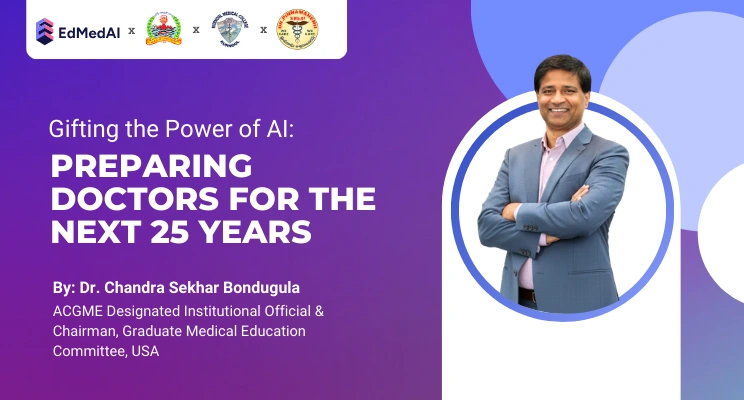
There are moments in life that bring you full circle.
Moments that remind you of where you started, how far you’ve come, and why every step of the journey was worth it. My recent visit to Kurnool Medical College, my alma mater, was exactly one of those moments.
On Saturday, 21st February 2026, I had the opportunity to return to Kurnool Medical College—the institution where my journey in medicine began.
I walked back through those gates not just as an alumnus but also as a physician executive, as Chairman of the Graduate Medical Education Committee, and as a global medical educator who has spent decades building expertise across India and the United States.
Yet, standing in those corridors again, titles seemed secondary. At heart, I remain a student shaped by KMC.
I went back carrying something I hoped would matter—to launch EdMedAI, built for every Indian medical student and faculty member in the nation.
And I went back with one simple desire: to give back to the institution that gave me my medical education foundation.
Entering KMC: A Walk Through Memory and Purpose
Crossing those gates after many years was deeply personal. The lecture halls, the wards, the familiar academic energy—everything brought back memories of being a young medical student with dreams in my eyes.
KMC gave me more than a degree. It gave me discipline, clinical grounding, and resilience—qualities that later allowed me to navigate international medical systems with confidence.
To honor that foundation, giving back felt like a responsibility through empowerment.
The Hall Was Full—and So Was My Heart
I had no idea what to expect walking into that orientation session. What I found was something far beyond what I had imagined.
The hall was packed—the Principal, Vice Principals, Heads of Departments, faculty members, and students all came together with a high level of enthusiasm and energy. Seeing the lecture hall packed to capacity and engaged throughout the session reflected something powerful:
Indian medical education is ready for digital transformation in medical colleges.
Before the session began, one moment quietly touched me: a close friend from our student days had canceled a scheduled trip to attend my session. That gesture reminded me that the bonds formed at KMC endure across decades.
And then came a moment I will never forget—being felicitated by my own professors.
To Be Felicitated by Your Own Professors
I have been recognized in conferences, boardrooms, and international settings. But nothing compares to standing before the teachers who once taught you, acknowledging your work. To have your closest friends and batchmates—now respected professors and HODs—witness that moment made it even more meaningful.
Recognition from those who shaped you carries a weight that no external accolade can match.
What moved me most, however, was the response from the students. The feedback was filled with warmth, curiosity about AI-powered medical education, and excitement about how EdMedAI could support the Competency-Based Medical Education (CBME) framework.
Students came up to me personally, thanking me for creating the platform and sharing how useful they already found it and how it made complex topics feel accessible and engaging.
What Giving Back Really Means
When professionals succeed, giving back often takes the form of infrastructure—buildings, equipment, and financial contributions.
Those are valuable.
But I asked myself a different question:
What if the contribution could multiply its impact every year?
What if it could strengthen not just one batch—but every future batch under the NMC CBME curriculum?
True giving back is capacity building.
That reflection led me to offer the EdMedAI CBME platform to participating institutions.
A Broader Beginning
Beginning March 1, a three-month pilot will launch at Kurnool Medical College with students, faculty members, and Heads of Departments. A parallel pilot will run at Dr. PSI Medical College, Vijayawada.
This pilot serves as a structured evaluation of an NMC CBME AI platform for medical education under real academic conditions.
Technology in education must be introduced thoughtfully, respecting institutional culture and ground realities.
The visit to KMC was not the starting point of this journey — it was part of a larger academic movement to integrate artificial intelligence in undergraduate medical education across institutions.
On February 3, 2026, I had the privilege of presenting EdMedAI, an NMC CBME-based AI medical education platform, to Dr. NTR University of Health Sciences and its 38 affiliated medical colleges. The discussions centered on the structured implementation of AI tools aligned with the UG medical curriculum in India.
Shortly thereafter, on February 13, I conducted the first pilot AI orientation session at Dr. Pinnamaneni Medical College and Research Foundation, Vijayawada – marking the beginning of a structured eCBME platform deployment under real institutional conditions.
This pilot initiative has been made possible through the gracious support and encouragement of Dr. P. Chandrasekhar, Hon’ble Vice Chancellor, NTRUHS; Dr. T. Sai Sudheer, Hon’ble Registrar, NTRUHS; and Dr. M. Lakshmi Surya Prabha, Director of Research, NTRUHS.
I am equally grateful to Dr. K. Chitti Narasamma, Hon’ble Principal of Kurnool Medical College, and Dr. (Major) MV Bhimeshwar Rao, Hon’ble Principal of Dr. Pinnamaneni Siddhartha Medical College, for their leadership in embracing this academic innovation and participating in the pilot phase.
Their leadership reflects openness toward responsible AI adoption in Indian medical colleges.
What is EdMedAI
EdMedAI is a CBME-based AI medical education platform built specifically for undergraduate (UG) curriculum delivery in India. The platform is built entirely in alignment with the NMC CBME-based curriculum—the regulatory framework that governs medical education across India.
It functions as a comprehensive eCBME software. Every competency, every subject, every learning outcome is mapped precisely to what the National Medical Commission requires. The platform supports compliance, competency development, and academic governance within the NMC regulatory framework.
Here is what it offers:
- Complete Competency Mapping: Digital tracking of all 2,695+ competencies across 19 subjects and 4 professional years.
- Interactive & Real-Time Clinical Simulations: Students don’t just read about clinical cases; they engage with them dynamically, building diagnostic reasoning and clinical judgment in a simulated environment that mirrors real-world practice.
- Digital Logbooks: One of the most time-consuming and frustrating aspects of medical training has been the manual logbook. EdMedAI replaces this entirely. Students submit entries digitally; faculty review and sign at their convenience. Hours of unnecessary waiting are eliminated.
- AETCOM Module: Dedicated tracking of Attitude, Ethics, and Communication competencies as mandated
- Family Adoption Programme (FAP): Systematic logging of community health visits with faculty verification
- Attendance & Faculty Workload Tracking: Institutions gain real-time visibility into attendance patterns and faculty engagement, making administrative oversight smarter and less burdensome.
- AI Analytics Dashboard for Administrators: Vice Chancellors, Principals, and institutional leaders have access to a custom analytics dashboard with heat maps, compliance reports, and activity monitoring—giving them the data they need to lead their institutions with clarity.
- Shared Content Library: Faculty can create, curate, and publish resources that flow directly to students. Everyone learns from the same high-quality material. This creates something that has long been missing in medical education: uniform standards of learning, accessible across every college and university.
Every feature reflects lessons drawn from years of experience in graduate medical education in the United States and is adapted for Indian institutions, not simply transplanted.
The objective is straightforward: reduce process friction so that more time can be devoted to teaching and clinical excellence.
Preparing Doctors for the Next 25 Years
Medicine is entering a period of rapid technological transformation. Artificial intelligence is already influencing diagnostics, imaging, predictive analytics, and healthcare systems management.
The question is no longer whether AI will become part of healthcare.
It already is.
The real question is whether we are preparing students for the system they will inherit. The next 25 years will demand physicians who are:
- Clinically strong
- Ethically grounded
- Technologically literate
AI will not replace clinical judgment. But doctors who understand digital tools and data systems will be better equipped to lead.
Structured exposure to AI tools for undergraduate medical students allows future physicians to adapt confidently — whether they practice in India or globally.
Through a CBME-based AI platform like EdMedAI, we can strengthen our graduates so they remain relevant, competent, and globally competitive.
Back on the Cricket Ground
After the session, my friends took me to the old cricket ground where we once played as students—carefree, ambitious, and full of dreams.
Standing there again, surrounded by those same classmates, time seemed to collapse in the most beautiful way.
In those few moments, I was not a chairman or an educator or an executive.
I was just a student again—one who had been given an incredible foundation by this institution and who now, decades later, was trying his best to repay that gift.
A Continuing Responsibility
Returning to my alma mater reinforced a simple truth: professional journeys are never individual achievements.
They are shaped by institutions, mentors, peers, and communities.
If I can contribute to strengthening AI readiness in healthcare education, even modestly, to the institution that shaped me and across Indian medical colleges, I consider it both a privilege and a responsibility.
This initiative is only a beginning.
The larger goal remains constant—to support medical education in India in a way that prepares our students not for today but for the future.
A Question for Academic Leaders Across India
To my fellow alumni, educators, academic leaders, and policymakers across the country:
How are we preparing our students for the digital transformation that will define the next 25 years of medicine?
AI in medical education is no longer optional.
It is inevitable.
If we integrate it thoughtfully within the NMC CBME framework, we can ensure that every future doctor trained under the UG curriculum is equipped not just for today’s clinical demands but for tomorrow’s healthcare ecosystem.
The future of medicine will belong to those willing to adapt.
Let us prepare our students for that future.
For India. For every future doctor who deserves to learn at the highest global standard. And for every institution ready to lead that transformation.